
#566 - BP Measurements, Perioperative Anticoagulation, Funhouse Mirror
Take 3 – Practical Practice Pointers©
From the Literature
1) Measuring Important Things Well – Blood Pressure
As we know, hypertension is an underlying cause for lots of disease in the US – strokes, heart attacks, kidney failure, etc. Using the 2017 ACC/AHA guideline thresholds of 130/80 to define the line of high blood pressure (BP) – approximately 50% of patients have hypertension, but only ¼ of that group are actually controlled. The measurement of office BPs is fraught with variability: recent smoking, a long walk from the parking lot, chattiness, or fidgetiness all wreak havoc on our attempts to measure what is meant to be a “resting” BP.
There are many aspects of patient preparation that are recommended to produce the best office-based BP readings: emptying the bladder, proper cuff size, uncrossed legs, feet on the floor, no talking, and the cuff on a bare arm. Researchers from Johns Hopkins have studied the position of the measured arm during BP measurement, citing variability in what is done in the real world of busy ambulatory clinics.
The researchers studied three groups of patients – each underwent three BP measurements in each of three positions (which were randomized for each patient): arm supported on a desk with mid-cuff at heart level (“desk”), arm resting on the patient’s lap (“lap”), and arm unsupported hanging at the side (“side”). The desk position is the recommended positioning in major blood pressure guidelines. Each patient had their BP taken (in triplicate) using the desk position at the end of the randomized measurements as a fourth reading to account for variability of BP over time. The average of the three BPs taken in each position was used for the analysis. Subjects were adults, non-pregnant, and had normal cognition. They recruited people from grocery stores, through mailings, and in hypertension clinics. The analysis looked at the differences between average blood pressures in each position. The study was overall carefully done except for relying on Microsoft Excel for statistics – the researchers found out in the middle of the study that it couldn’t randomize the groups well enough, so they had to straighten all that out in the analysis.
133 patients were randomized, most were above age 60, 77% were black, 41% were obese. BP measurements using lap and side techniques were compared with the desk measurements as reference. Lap measurements of systolic BP were 3.9 (95% CI, 2.5−5.2) mmHg higher than desk, and side measurements were 6.5 (95% CI, 5.1−7.9) mmHg higher. Lap measurements of diastolic BP were 4.0 (95% CI, 3.1−4.9) mmHg higher and side measurements were 4.4 (95% CI, 3.4−5.4) mmHg higher. There were no important subgroup differences, and the randomization problems did not have any important effect on the results in a sensitivity analysis.
The authors conclude that ensuring the arm-supported-on-desk positioning can lead to clinically meaningful differences in BP and recommend taking BPs using this method.
John’s Comments:
Taking blood pressures is one of the first clinical skills we learn, and maybe because it’s so fundamental and common, we overlook the need for reliable quality. It’s worth heeding this study and paying attention to the other BP measurement guidance from the Million Hearts Campaign (example: Proper BP monitoring)
References:
· Liu H, Zhao D, Sabit A, et al. Arm Position and Blood Pressure Readings: The ARMS Crossover Randomized Clinical Trial. JAMA Internal Medicine. Published online October 7, 2024. Link
From the Literature and Question From a Colleague
2) Perioperative Management of Oral Anticoagulation
Question: “What are the latest recommendations regarding perioperative anticoagulation? I don’t think you’ve covered this for a while.”
Answer: In 2022 the American College of Chest Physicians updated their 2012 guideline addressing this challenging, important, and often confusing aspect of clinical care. The guideline defines procedure risk in terms of potential morbidity from blood loss as follows:
Minimal-bleed-risk procedures include:
- Minor dermatologic procedures (excision of basal and squamous cell skin cancers, actinic keratoses, and premalignant or cancerous skin nevi)
- Ophthalmologic (cataract) procedures
- Minor dental procedures (dental extractions, restorations, prosthetics, endodontics), dental cleanings, fillings
- Pacemaker or cardioverter-defibrillator device implantation
Low to moderate risk procedures include:
- Arthroscopy
- Cutaneous/lymph node biopsies
- Foot/hand surgery
- Coronary angiography
- GI endoscopy biopsy
- Colonoscopy biopsy
- Abdominal hysterectomy
- Laparoscopic cholecystectomy
- Abdominal hernia repair
- Hemorrhoidal surgery
- Bronchoscopy biopsy
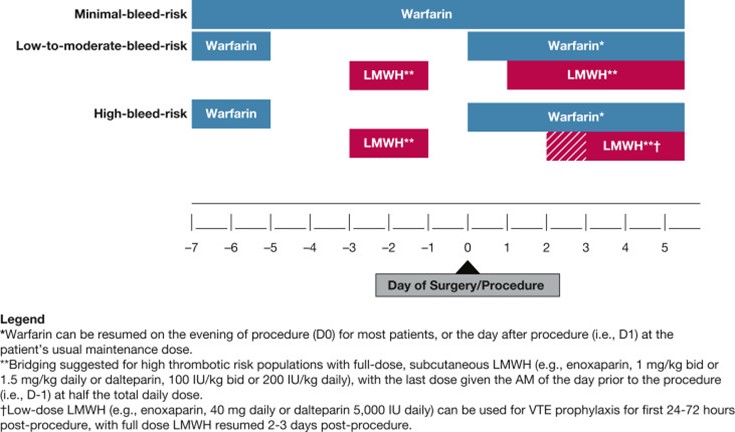
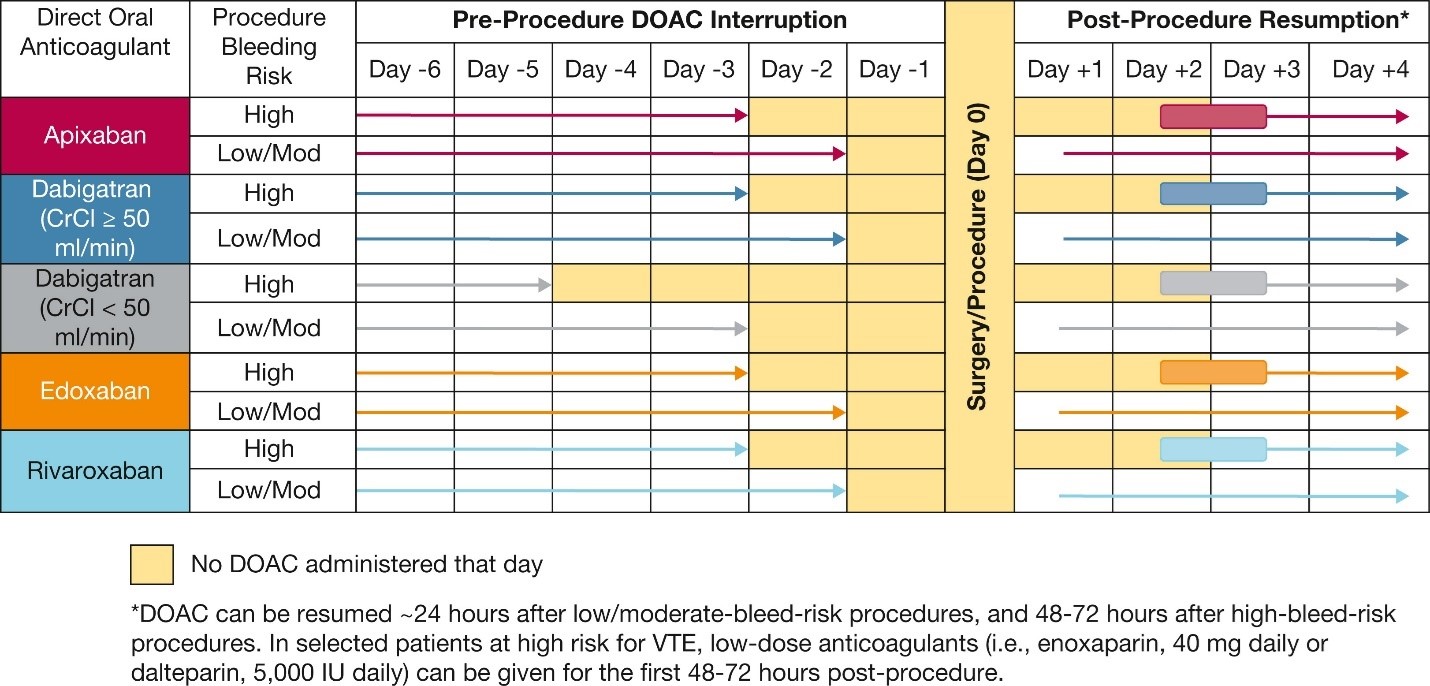
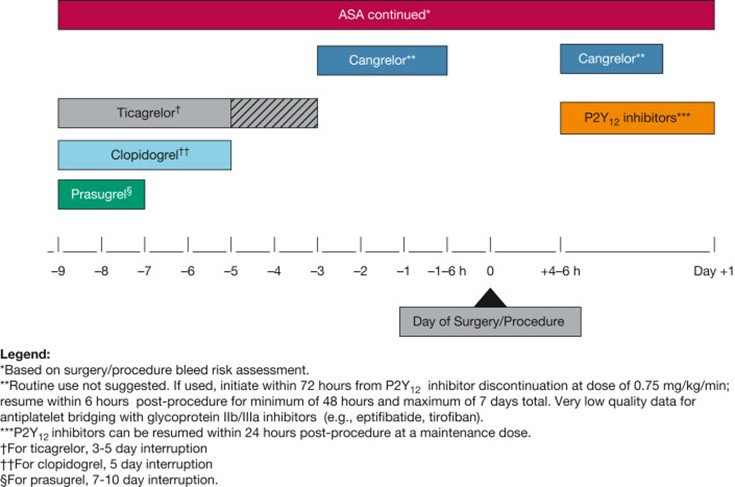
In reviewing this extensive guideline, the three figures below from the guideline provide a wonderful and practical visual for the management of these patients.
1. For the perioperative management of vitamin K antagonists (warfarin) (LMWH = low-molecular-weight heparin):
2. For the perioperative management of direct oral anticoagulants (DOACs):
3. For the perioperative management of antiplatelet drugs (ASA = aspirin):
Mark’s Comments:
I’ve found these tables quite helpful, particularly for common dental and ophthalmologic procedures for which we’re asked regularly to provide “clearance.” The stakes are high. Keep them handy.
Reference:
Douketis J, et al. Perioperative Management of Antithrombotic Therapy:
An American College of Chest Physicians Clinical Practice Guideline. Chest, 2022;162(5):e207-e243. Link Executive Summary: Link
From PeerRxMed ( www.PeerRxMed.org )
3) Embracing Our Imperfections: Lessons from a Funhouse Mirror
"To be yourself in a world that is constantly trying to make you something else is the greatest accomplishment." – Ralph Waldo Emerson
As clinicians, we often hold ourselves to impossibly high standards, scrutinizing every aspect of our clinical performance. This has been socialized into us since the beginning of our medical training and for most of us, many years prior to that. While these standards exist for a good reason, this can result in a self-critical mindset that often spills over into our personal life and leads to feelings of inadequacy and self-doubt. For many, this includes our personal appearance as well.
Pause for a moment and consider things about your appearance that you don’t like. We all have them. What if we could reimagine our perceived flaws and see them through a different lens?
Recently while spending some time with friends on our patio, we noticed that a mirror there caused distortions of our reflections like those of a funhouse mirror. We laughed hysterically at the absurdity of elongated necks, bulbous heads, enormous ears, and body builder biceps. Later, as I reflected as to how easy it was to find these exaggerated distortions humorous, the thought struck me – what if I could apply this same light-hearted perspective to my real-life "flaws"? How might I learn to laugh at my imperfections instead of letting them too often weigh me down?
Indeed, it is quite easy, particularly in our social media saturated world, to lose sight of our inner beauty and sense of self-worth and instead fixate on anything we view as “wrong” with us. Just as the funhouse mirror's distortions are not a true representation of reality, neither are our self-critical thoughts. By acknowledging that our perceptions are often distorted – whether by a funhouse mirror or our internal critic – we can begin to view ourselves with greater self-compassion. Through this lens, we can start to challenge and reframe these negative perceptions, allowing for a more balanced and forgiving self-view.
Yes, we can be our own harshest critics. Next time you catch yourself fixating on a flaw or mistake, try to imagine it reflected in a funhouse mirror. Laugh at the distortion, recognize its exaggeration, and remind yourself that imperfections are a natural part of being human. Embrace the unique qualities that make you who you are and remember that your worth is not defined by your perceived flaws. Consider sharing some of these challenging thoughts with your PeerRx partner and laugh together at these silly but quite real perceptions. By catching your negative self-talk early and practicing this more playful perspective of humor and acceptance, you will add the spirit of the funhouse mirror to your well-being toolbox. It has sure helped me laugh at my “Dumbo” ears, which, I smile and remind myself, are not.
______________
Mark and John
Carilion Clinic Department of Family and Community Medicine
Feel free to forward Take 3 to your colleagues. Glad to add them to the distribution list.
Email: mhgreenawald@carilionclinic.org