Neurochemical and Neurophysiological Assessment During Surgery: Parkinson’s, Dystonia and Essential Tremor
This study will provide working data on the functioning of a single brain cell (neuron) and anatomy of the brain by using active “thinking” and passive “resting” tasks while taking measurements of brain activity during deep brain stimulator surgery.
About
The primary purpose is to measure dopamine and serotonin while participants navigate games designed to test theories about how the brain encodes information. Secondary goals will be to relate these measurements to behavior that can inform us about individual differences in how brains process information and how these processes are altered in patients with psychiatric and neurological conditions.
Protocol Description
This study is designed for patients undergoing deep brain stimulation surgery for medical reasons. Participating patients will be asked to complete tasks and questionnaires during the surgery in which the electrode is implanted. They will also be invited to participate in a voluntary functional MRI (fMRI) scan.
Eligibility Criteria
Inclusion Criteria
- Patients diagnosed consented to DBS electrode implantation for clinical care reasons
- Age 18-85
- Vision correctable to be able to see the computer display clearly with or without eyeglasses
Exclusion Criteria
- Dementia or severe cognitive impairment (DRS-2 score less than 120)
- Severe depression not controlled by pharmacotherapy
- Pregnant
- Inability to stop taking blood thinners
- Unable to consent
- For MRI subsection only: contraindications to MRI (such as pacemaker, aneurysm clips, neurostimulators, cochlear implants, non-removable body piercings, physical limitation to entering scanner, claustrophobia); MRI contraindications will be confirmed prior to conducting the MRI and participants will be asked to review the MRI screening form to confirm no contraindications prior to the MRI scan
Primary Investigator
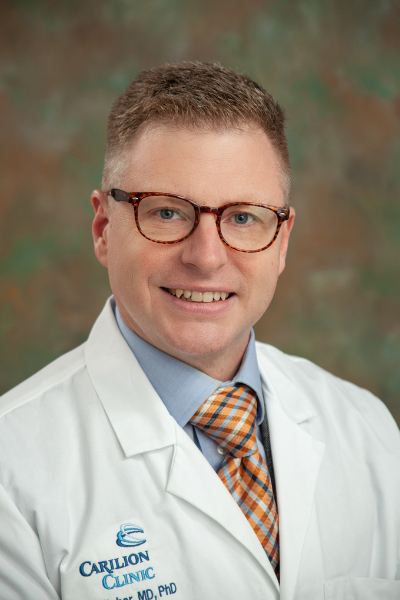
Mark Witcher M.D., Ph.D., completed his medical education and training with a focus in neuroscience, as well as neurosurgery residency and fellowship in functional neurosurgery. He was fortunate to train under mentors focused on translational neuroscience—integrating neurosurgical research into clinical neurosurgical practice—and Carilion Clinic Neurosurgery provides an incredible opportunity to continue the tradition.
Dr. Witcher specializes in helping patients with functional neurosurgical issues. He has dedicated many years to studying electrical signaling in the brain to better understand the neuron behaviors that cause tremors, seizures, movement disorders, pain, weakness, sensory symptoms and blackouts.
Contact Information
Jordan Darden, Ph.D.
Director of Neurosurgery Research