- Only about 1/3 of U.S. adults have made a formal end-of-life plan.
- It covers a broad range of medical preferences and the documentation to support them.
- It also includes choosing someone to represent you and having difficult conversations about it.
Have you thought about end-of-life care or put your wishes for care down on paper? If not, you are not alone.
According to a recent study, only about a third of U.S. adults have documentation, and people with chronic illnesses were only slightly more likely than healthy individuals to put their wishes down on paper.
We understand that it is not something you want to think about, but planning for the end-of-life is crucial for you and your family, even if you are healthy.
End-of-life care refers to health care that a person might receive in their final months or weeks.
The process does not have to be daunting or complicated. Lisa T. Sprinkel, M.S.N., R.N., senior director of Carilion Clinic Home Care and Hospice, broke it down for us into five steps.
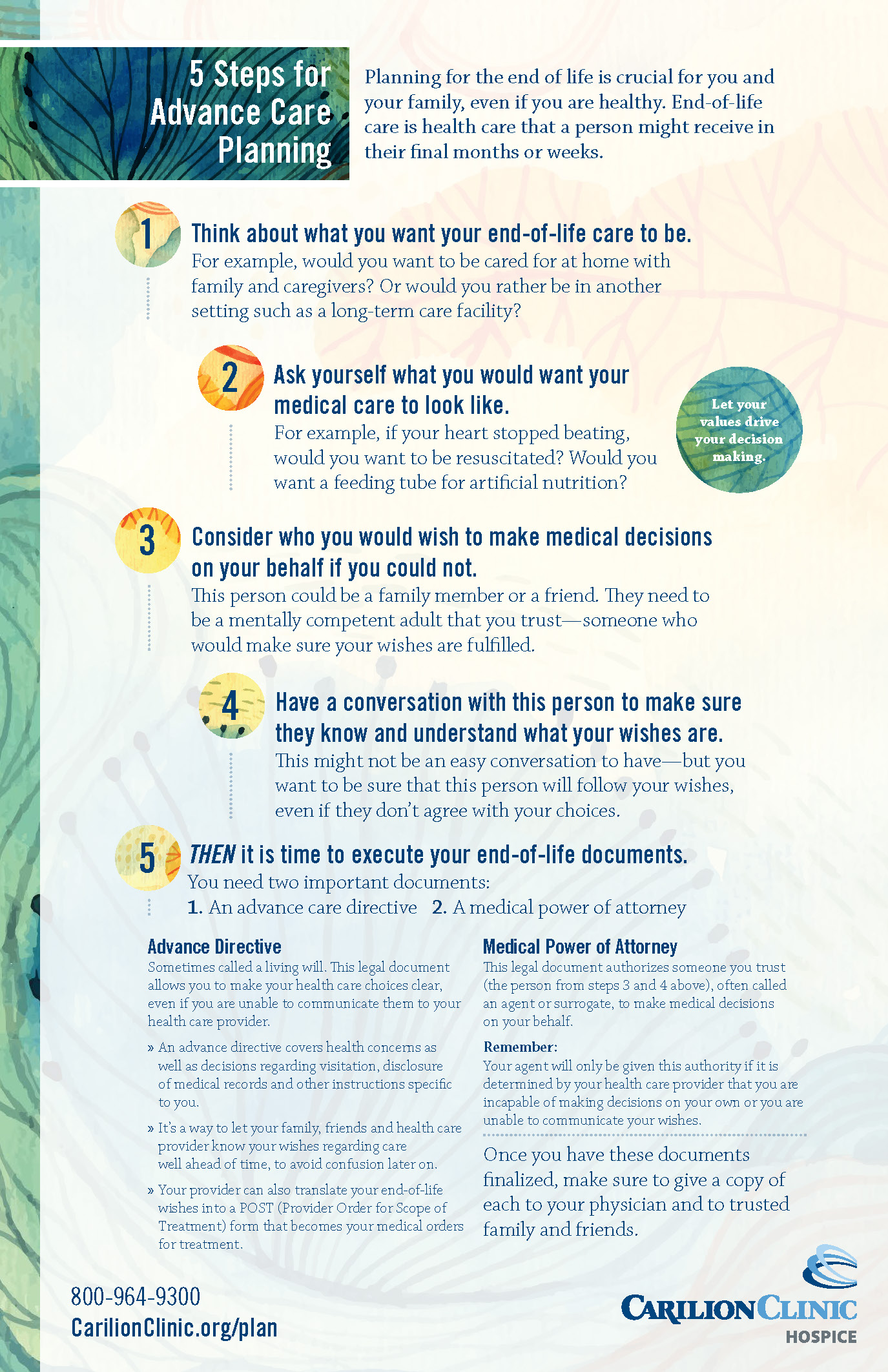
Check out the infographic below for an easy-to-read version!
1. Think about what you want your end-of-life care to be.
For example, do you want to be cared for at home with family and caregivers? Or would you rather be in another setting such as a long-term care facility?
A study recently found that 90 percent of patients dealing with a life-limiting illness prefer to receive their end-of-life care at home; yet, only one-third actually did.
2. Ask yourself what you would want your medical care to look like.
Let your values drive your decision making.
If your heart stopped beating, would you want to be resuscitated? Would you want a feeding tube for artificial nutrition?
3. Contemplate who you wish to make medical decisions on your behalf if you can't.
This person could be a family member or a friend. Just make sure your agent is a mentally competent adult that you trust and would assertively ensure that your wishes are fulfilled.
4. Have a conversation with this person to make sure they know and understand what your wishes are.
This might not be an easy conversation to have, but you want to be sure that this person will follow your wishes, even if they don’t agree with your choices.
It is also important to make sure that they are willing to accept this responsibility.
5. THEN it is time to execute your end-of-life documents.
There are several documents available for end-of-life planning, but Sprinkel notes that two important documents to include are an advance directive and a medical power of attorney.
Advance Directive
An advance directive, or what is sometimes referred to as a living will, is a legal document that allows you to make your health care choices clear even if you are unable to communicate them to your doctor.
Advance directives address health concerns as well as decisions regarding visitation, disclosure of medical records and other instructions specific to each individual.
It is also a way to let your family, friends and physician know your wishes regarding care well ahead of time; thus, avoiding confusion later on.
Your physician can also translate your end-of-life wishes into a POST (Physician Order for Scope of Treatment) form that becomes your medical orders for treatment.
Medical Power of Attorney
A medical power of attorney is a legal document that authorizes someone you trust (see step 3 and 4 above), often called an agent or surrogate, to make medical decisions on your behalf.
The agent will only be given this authority if it is determined by your doctor that you are incapable of making decisions on your own or you are unable to communicate your wishes.
Once you have these documents finalized, make sure to give a copy of each to your physician and to trusted family and friends.
To obtain an advance directive form, contact your physician or download this PDF from the Virginia State Bar.
If you are unsure about the kind of end-of-life care you want to receive, talk to your physician today.