Orthopaedic Research
At our Musculoskeletal Education Research Center, medical students partner with our orthopaedic surgeons and biomedical engineering scientists to look for ways to improve surgical procedures and solve rehabilitation challenges.
MERC
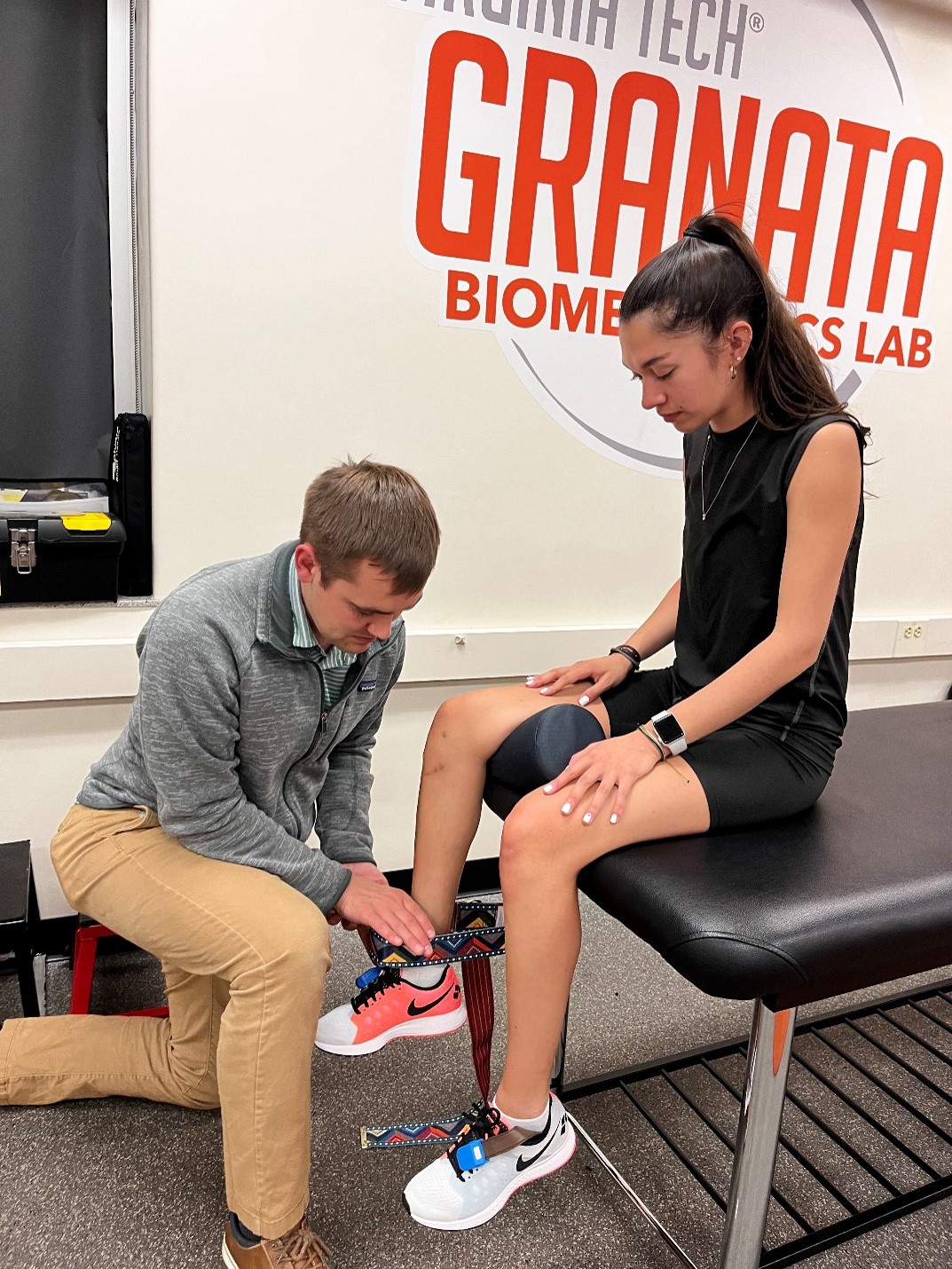
A patient-athlete, on the road to recovery after knee surgery and hoping to start competing again soon, is working through her physical therapy exercises. On her leg are sensors that measure the activity in her muscles while she performs the exercises, providing feedback that tells her to adjust her movements as needed to target the right muscle groups. This is called biofeedback, and it's one example of the cutting-edge research areas that our surgeons and Virginia Tech Carilion students are working on together through the Musculoskeletal Education Research Center (MERC).
The Center was created in 2013 to bring together clinicians and researchers within the Department of Orthopaedic Surgery and introduce medical students to research through real-world applications.
“With Virginia Tech Carilion and the Fralin Biomedical Research Institute here, there was an opportunity to bring together the work of these various groups,” says Jonathan Carmouche, M.D., M.B.A., vice chair of the Department of Orthopaedic Surgery.
First-year medical students are encouraged to share their academic backgrounds and research interests with MERC so they can be matched with a mentor, or to reach out directly to a mentor they would like to work with. Students and their mentors typically partner one-to-one on research projects. Their work is supported by MERC clinical research coordinators, clinical research assistants and Health Analytics statisticians. MERC holds a conference once a month where students can present their research to get helpful feedback from surgeons in Orthopaedics and other related specialties like Emergency Medicine and Radiology. The team has grown to include four research fellows and collaborates with Virginia Tech’s Biomechanics Laboratories.
“Curiosity is an important aspect of providing excellent care, and we want to foster this important trait for the next generation of doctors,” says Dr. Carmouche.
Research ideas are plentiful at MERC, often inspired by challenges seen in our Orthopaedics clinics. But before any idea can become a project, ‘yes’ answers are needed for several questions. Does the topic have significant potential impact for patients? Will the research process meet ethical standards? And are the required resources available—expertise, time, funding, equipment, participants? This last question is part of why MERC exists: “Having experts available to collaborate from multiple specialties is key,” says Dr. Carmouche. “A successful project comes down to planning, time and resources. Collaborating allows for these to be as efficient as possible.”
One of the goals for a successful project is to obtain grant funding for clinical trials, because this allows MERC teams to expand their research into larger patient populations. These are two of its current clinical trials:
Sample Research Studies
ACL Rehabilitation Study
This study was partly inspired by the orthopaedic care we provide student-athletes at nearby universities. Its goal is to learn more about rehabilitating athletes who have had surgery on the anterior cruciate ligament (ACL), an important ligament in the knee. Researchers are looking at the use of biofeedback during physical exams to determine when an athlete can start competing again after ACL surgery. The research team discovered how important symmetry—meaning similar levels of strength, stability and range of motion—between the surgically repaired knee and the uninjured knee is for preventing re-injury. Now they are enrolling more patients in the trial and collecting more information that could potentially help care teams know whether an athlete is ready to play again or still at higher risk of re-injury. Looking ahead, the team hopes to expand their biofeedback research into studying how different types of footwear may affect recovery after foot or ankle surgery.
Minimally Invasive ACDF Study
This study is looking at a different way of performing Anterior Cervical Discectomy and Fusion (ACDF), which is a surgical procedure to treat spinal conditions in the neck. During ACDF, the surgeon uses an autograft—a small piece of bone taken from the patient's own body—to replace a spinal disc in the neck. Generally, that piece of bone is taken from the patient's hip bone. But MERC researchers are looking at the potential benefit of using a piece of bone from the same area as the surgical site instead, to eliminate the need for a second incision. This project is being funded by Carilion’s Research and Development department through a Research Acceleration Program grant, and is being actively recruited for further grant support by MERC's first research fellow, Linsen Samuel, M.D., M.B.A.
"While our study populations may have been the first group of patients to benefit from these studies, anyone who undergoes an ACL or ACDF surgery will as well," says Dr. Carmouche—an example of why another important goal shared by MERC researchers is to publish their findings in scientific journals where other orthopaedic surgeons can learn about them. That's how ideas that start at MERC can lead to better care first for our patients and, ultimately, patients everywhere.
Interested in learning about more MERC research? Check out this list of published student research projects.
Questions
For more information about the Musculoskeletal Education Research Center contact Jonathan Carmouche, M.D., M.B.A., Orthopaedic Surgery, at jjcarmouche@carilionclinic.org.